The Galef Oceanside Asylum
2020
Welcome to the Galef webspot. Our
continuing mission is to explore our universe and even if we
don't boldly end up where no one has gone before, we hope to
make some new friends on the way.

Our Chihuahuas-in their younger and slimmer days
For years a picture of Mr. Cichlid graced this page. He started out as a tiny black and white striped baby the size of the tip of my thumb and grew into a foot-long monster who constantly built hills and valleys in the gravel of his aquarium and threw the rest against the sides. He scraped his teeth against the glass to make his annoyance known when he was hungry. He splashed water everywhere when his tank was being cleaned. He was a Hornet Tilapia and typical of his species he killed all of his original tankmates and made it known that he didn't want any company. He bit and drew blood anyone brave enough to put a finger in his tank. He was a $2 fish who ate $5 of frozen food a month for 16 years. Most sources say that this fish typically lives around ten years,but he lasted from 2002 until 2018. In the middle of that summer he started eating less and less and then stopped entirely. Several times I thought he was gone but he started splashing when I came with the net. He finally he swam off to the big aquarium in the sky. I sort of miss him; sometimes...
HALLOWEEN 2020
There isn't much
that I can say about this year that isn't obvious and hasn't
been decried and deplored by others. Fairly early in
the year it became apparent that my pumpkin, if I were even
to do one, would have to involved the Corona Virus.
The question was, how to do it? I had already seen
editorial cartoons showing an asteroid with spikes slamming
into Earth and other ways of depicting the chaos and
destruction that it caused. Finally as October
arrived, our First Lady told us what she really thought
about decorating the White House for the Holidays. I
thought, "What a Grinch!" and found an image from a DVD of
the Grinch and Photoshopped her green-tinted image onto the
Grinch's body. Such a great concept deserved more than
one twist and therefore the Grinch got another role as a
Corona Virus stealing not just Christmas or Halloween, but
all of 2020. Instead of Cindy Lou Who, he shared the
stage with a sad little trick or treater holding an empty
bag. For good measure, he got a familiar blond upswept
'do. Although our house was dark for the big day, my
neighbor was more than happy to display my work (and even
hinted that he took credit for it when people asked), so it
did get some exposure. In a year when my brother
decided not to carve, someone had to maintain the family
tradition! Here is How the 'Rona STOLE 2020!

How the 'Rona STOLE 2020
HALLOWEEN 2019
I'm back. For this year's
offering I present Dancing With (the)
Scars. I have tossed this idea around in
my mind for quite a while but was never quite sure how to make
the dancers hop instead of appearing to be waiting for the
dirge to begin. I remembered an old image of a couple of
satyrs frolicking but wasn't sure that I could find it.
Luckily, a quick riffle through my "archives" (stuff I haven't
really unpacked since moving here in 1980) I found what I was
looking for, an old promotional piece from KHJ radio listing
the top 300 songs of all time as selected by their
listeners. It lent itself to easy modification as a
quick web search produced good images of the Monster and the
Bride of Frankenstein. I played musical heads, added
some bandages and rips in their clothing and started
carving. Well, I am not too sure which dancer is the
star and which is the pro, but the judges definitely gave them
10's (or else) while the crowd reached for their torches and
pitchforks.

DANCING WITH (the) SCARS
HALLOWEEN 2018
For the first time in over 40
years, and maybe in my entire life, I wasn't home on
Halloween. We were in Tokyo where the Halloween scene in
Shibuya was crazy, even the next day. But, no pumpkin
carving. Maybe this year I will get back to it.
HALLOWEEN 2017
It has taken me a long tome to get
around to posting my pumpkin from 2017. Facebook has
pretty much taken over social media and most of my friends
expect me to post it there, usually after my brother puts his
on display. Somehow after that it takes me a long time
to get around to the hassles of editing this website and
posting it. Nonetheless, here is my pumpkin offering for
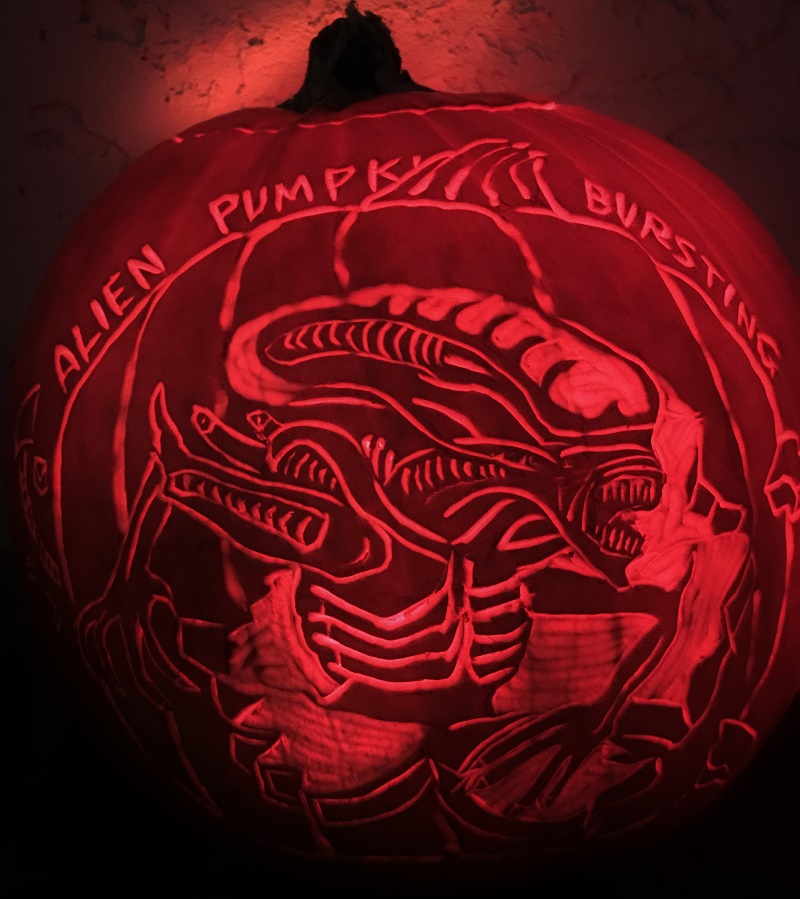
2017: In space, no one can hear a pumpkin burst.

HALLOWEEN 2015
"DAVID SLAYS THE GIANT PUMPKIN".
Face it, juvenile delinquents have been trashing other peoples' pumpkins for as long as they have been carving them. Usually they grab them and throw them in the street but sometimes they find other ways to gore the gourd. Here a youthful David has fired his sling at a large Philistine pumpkin on a Canaanite ritual stand. His missile has nailed it in the forehead and knocked it off its stand. Actually, David has a motive beyond undirected teenage angst. After he finishes his vandalism, he is wants to put a Price-Tag label on it. Well, that and target practice for an upcoming engagement tomorrow with some guy named Goliath.

HALLOWEEN 2014
HALLOWEEN 2013

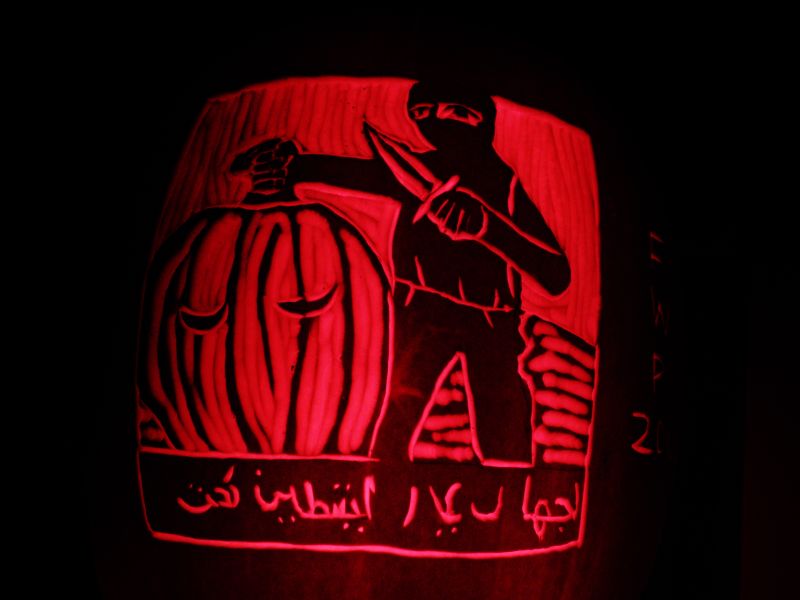
The text below reads: "EGYPTIAN PUMPKIN SMITING"
The pumpkin regards the Pharaoh with wedjat eyes. The wedjat was the Eye of Horus, a major good luck charm in Olde Egypt.
They are a bit hard to read, but the heiroglyphs on the cartouche to the left of the pumpkin read, "PUMPKIN-HOTEP" meaning "The Pumpkin is Pleased".
Well, the smitee may not be so happy, but the squash in the sky is smiling down on the scene. After all, it is beaming pumpkins down on everyone.
HALLOWEEN 2012

"SEEDS AND SAND"
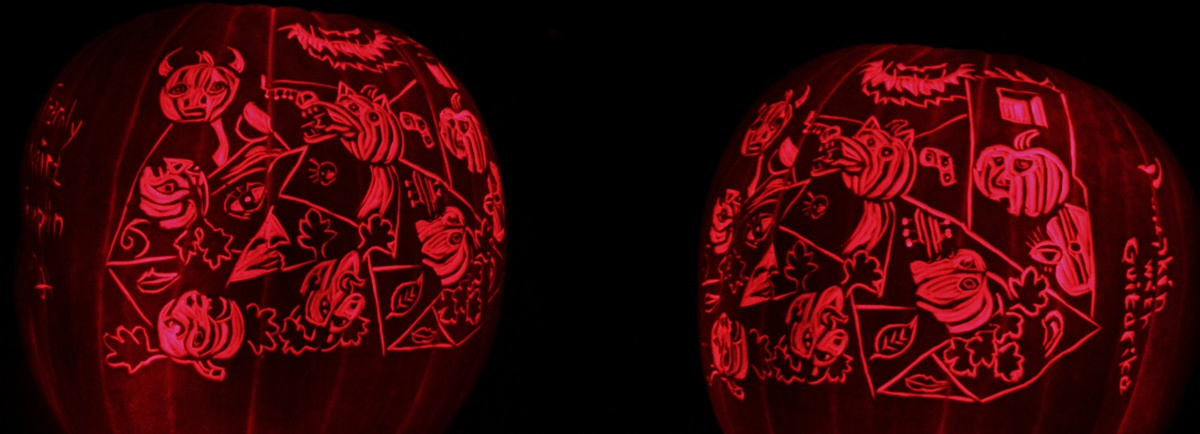
"PUMPKIN WITH GUITARIKA"

"PUMPE SKRIK", OR "PUMPKIN GETS MUNCHED"
HALLOWEEN PUMPKIN 2009

HALLOWEEN
PUMPKIN 2008
We spent a week in Bavaria last
month, and along with the onion-domed churches that are so
characteristic of German architecture, we were very impressed
with Ludwig II's fantastic castle, Neuschwanstein. The
walls inside are covered with murals inspired
by scenes from Wagner's operas. I figured that if
tales from Wagner were good enough for the King of Bavaria, they
were good enough to appear on my pumpkin. Here, in a scene
from Wagner's final opera, Parsifal, a naive and wild
young man who is unaware of his noble birth and fantastic
destiny, has stumbled into a magic realm. In a hunting
mood, not unlike a certain vice-presidential candidate, he has
shot the first thing he sees. Sadly, his victim is a
gentle and peaceful symbol of this mystical kingdom and he is
immediately taken to task by a noble knight whose job it is to
ensure the safety of all creatures near the holy castle.
While Parsifal gestures in protest that he is innocent, his
action will have far reaching consequences... but that is
another story. Well, in the original story, it was a
swan that Parsifal shot, but this is Halloween!
Here then is my 2008 Pumpkin,
"PARSIFAL UND DER RITTER VON DER HELLIG KURBIS"
(or PARSIFAL AND THE KNIGHT OF THE HOLY PUMPKIN)

HALLOWEEN PUMPKIN 2007

For those of you not up to date on your Cordon Bleu technique, the writing on the steps reads,
"La Méthode Française de tailler le citrouille".
Bon appetite!
**************************************************
Here are some links to some of my other pumpkins from the past:
2006: Aztec Calabeza Carver. After spending several days in Mexico City where the Aztecs once spent a lot of time making ritual sacrifices, this depiction of the source of pepitas seemed to make a lot of sense. Chac mol is keeping the priest company and awaits his share of the filling.

2005: Samurai Pumpkin Carver. This is also called the Zen of Kabocha Seppuku.

2004: BAD Halloween. Birds Are Dinosaurs. This was my spin on the classic Knight rendering of dueling Laelaps, an early name for Allosaurs.

2003: Hellvis. Condemned to play the accordion for eternity.

2002: Death Takes a Holiday. Hey, this IS Oceanside, remember?

1992: Tilting at Windmills. Just because you are tilting at windmills doesn't mean there aren't any dragons!

1991: Rubbed the wrong way! Be careful how you wish for what you want.

1990: Dueling Dinosaurs. A somewhat modified version of a John Gurche painting. I substituted a Triceratops for the Styracasaurus.

Also, if you want to see another take on Pumpkin Carving, check out my brother Barry's website, Jack O'Lanterns by Barry Galef! Barry goes for a more high concept type of approach. He seems to be in the Opera Seria genre, while I tend more to stay in the Buffa style.
During the years that our son was in school in northern Califonria, we made a lot of trips up and down this state. An important part of our history is the Mission system that was Spain's attempt to colonize California while stopping the Russians from encroaching from the north. There is a lot of controversy about the Missions and the people who were here first, but the old buildings and the museums associated with them are among the most fascinating places you can visit. Between the 1770's and 1820's, twenty one Missions were founded between San Diego in the south and Sonoma in the north. We were able to visit all of them, and some of our impressions are here, at Style Elements of the Missions.
LINKS
- Frank has a collection of trilobites that is available on-line at Among My Trilobites
- Frank also has a page of Dinosaur models, sketches, teeth and opinions at Where the Dinosaurs Are
- Everyone who sees my other webpages wants to know where my Penguins are. See Follow the Penguins .
- For Macho, may he be yapping in heaven, his page and photo gallery, see Besame Macho .
If you have comments or suggestions, email me at tyrarex+gmail.com
Use @ instead of + to make it work!